
Republic of Kenya
The Republic of Kenya is bisected by the Equator and East longitude 38°. The country shares borders with Ethiopia, Somalia, South Sudan, Uganda, Tanzania and the Indian Ocean.
Kenya at a glance
- Land area: 582,646 sq. km
- Capital city: Nairobi
- Population: > 53 million (2025)
- GDP growth rate: 4.6% (2025)
- Currency: Kenya Shilling (KES)
- Official languages: English and Kiswahili
- Government structure: National Government and 47 County Governments
The country enjoys a varied climate ranging from tropical to temperate and is enriched with a wide heritage of natural resources, which allows for a wide range of economic activities. In addition, the country has diverse wildlife, and thus a considerable acreage of land has been devoted to wildlife conservation habitats. These habitats include the famous Maasai Mara and Tsavo National Parks. All the Big Five animals of Africa are found within these habitats.
Petroleum Exploration History in Kenya
Petroleum exploration in Kenya began in the 1950s within the Lamu Basin. It was not until 2012 that the first commercially viable oil discovery was made in the Tertiary Rift, followed by significant gas discoveries in the offshore Lamu Basin.
Kenya has four (4) sedimentary basins namely: Lamu, Anza, Mandera and the Tertiary Rift, covering an area of approximately 500,000km2. The sedimentary basins are subdivided into 50 petroleum exploration blocks, of which 4 are licensed, and 46 are open for licensing to investors for oil and gas exploration. To date, 95 wells have been drilled by oil exploration companies in the four sedimentary basins.
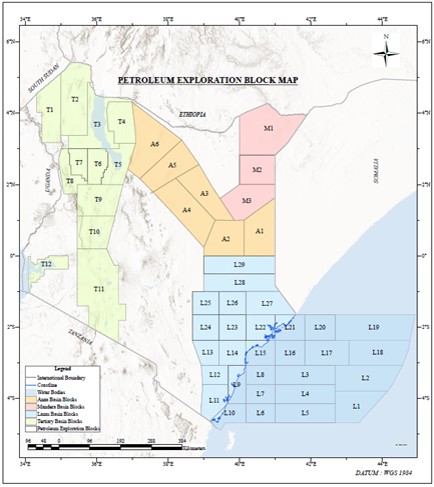
Petroleum Exploration Basins and Blocks Map
The well density is approximately one well for every 12,200km2. This presents a unique opportunity for exploration companies to invest in this frontier region. Out of the 95 wells drilled, 42 had hydrocarbon discoveries/shows. This, therefore, confirms that all four sedimentary basins have mature hydrocarbon systems capable of accumulating economic reserves where all petroleum system elements exist.
Legal Framework
The First Petroleum Exploration and Production legislation in Kenya was enacted in 1984 by Parliament and revised in 1986 to give incentives and sufficient flexibility to attract international oil companies and therefore stimulate oil exploration in the country. Currently, the governing legal frameworks are the Constitution of Kenya, 2010, the Petroleum Act, 2019 and Model Production Sharing Contracts (PSC). Petroleum Regulations are currently under development.
UPSTREAM PROJECTS
South Lokichar Field Development Project
The project targets development of six (6) fields within the South Lokichar Basin on phased and joint development strategy using shared infrastructure for viability. The Field Development Plan (FDP) was ratified by Parliament in February 2026 and the project is now in the development and production stage
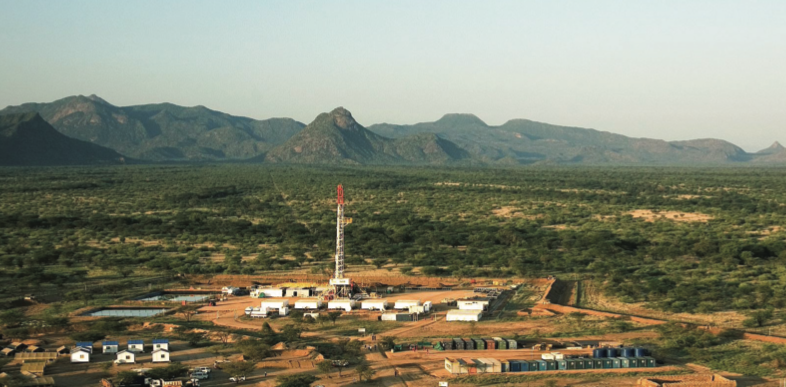
South Lokichar Project
Phase 1: Production Plateau of 20,000 barrels per day with first oil expected by December 2026 utilizing Early Oil Production Facilities (EPF). Crude oil will be transported by trucks to Kenya Petroleum Refineries Limited (KPRL) for storage before export.
Phase 2: Production Plateau of 50,000 barrels per day from 2032 involving construction of a Central Processing Facility (CPF). Crude oil will be transported via rail to KPRL for storage before export.
Ongoing activities include community sensitization, stakeholder engagement, and land acquisition processes to facilitate project implementation and ensure alignment with regulatory, environmental and social requirements.
Petroleum Resource Assessment
This initiative is aimed at enhancing the understanding and evaluation of Kenya’s petroleum potential through comprehensive geoscientific studies. The project involves the evaluation, processing and reprocessing of existing geoscientific data as well as the acquisition of new geoscientific data across prospective sedimentary basins. The project will strengthen the promotion and marketing of Kenya’s upstream petroleum potential to local and international investors by providing reliable, accessible and modern geoscientific information.
Development of Natural Gas Resources and Infrastructure
Kenya is increasingly positioning itself as a prospective natural gas frontier within the East African region, supported by recent exploration studies indicating significant gas potential across its sedimentary basins. Current resource assessments estimate mean prospective gas resources within the country’s open exploration blocks at approximately 134 trillion cubic feet (tcf), highlighting substantial opportunities for future exploration and development. To accelerate investment in the natural gas sector, Kenya has identified ten high-potential exploration blocks located within the Anza and Lamu Basins.
Detailed geoscientific atlases and promotional data packages have been developed for these blocks to support investor engagement and facilitate exploration activities by prospective upstream operators. Furthermore Kenya and Tanzania have entered into a bilateral agreement to undertake a feasibility study for the development of cross-border natural gas infrastructure between the two countries.
MID AND DOWNSTREAM PROJECTS
Promotion of use of Clean Cooking Gas in Public Institutions of Learning
The Government of Kenya, through the Ministry of Energy and Petroleum, is implementing a nationwide Clean Cooking Gas Programme aimed at transitioning public learning institutions from the use of traditional biomass fuels to Liquefied Petroleum Gas (LPG) as the primary cooking fuel.
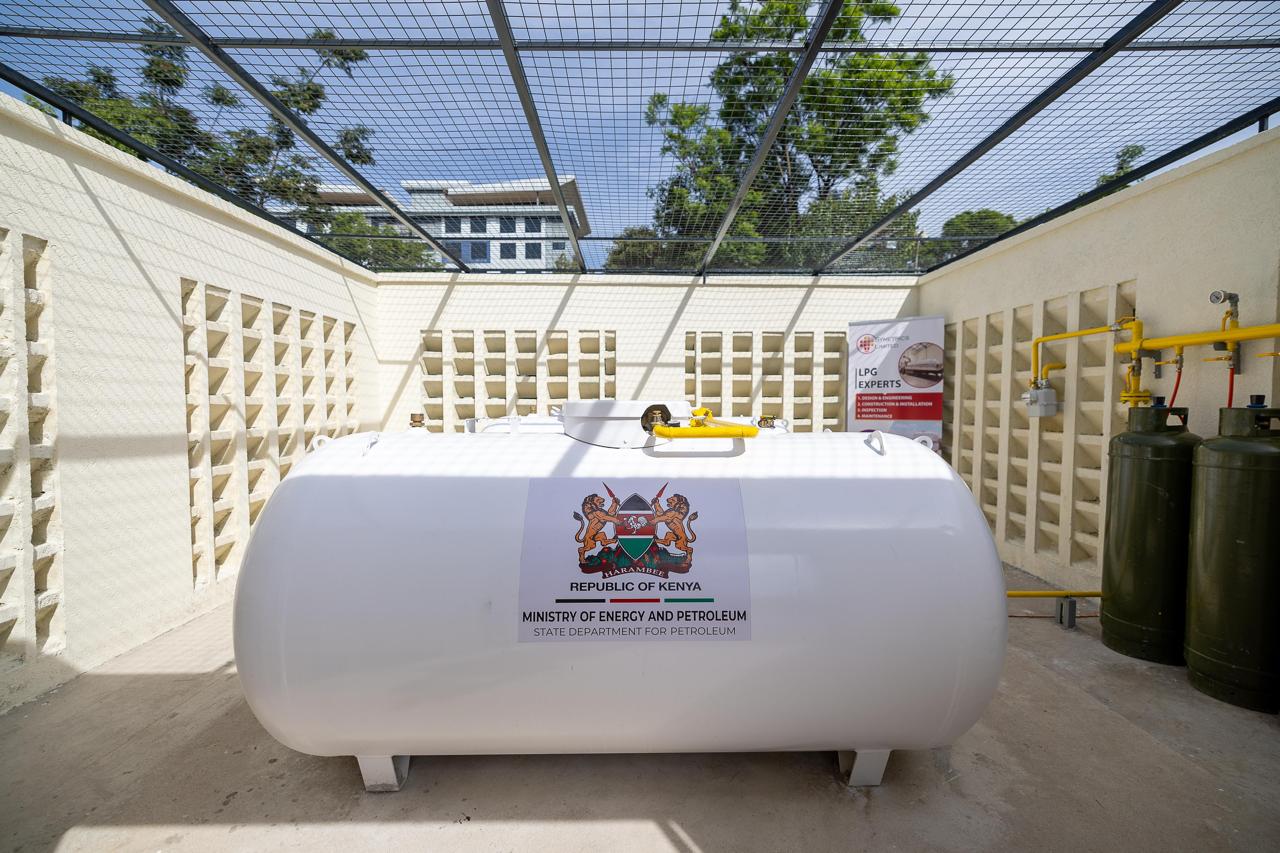
Commissioned LPG Cylinder for a High School in Kenya
This initiative supports the Government’s National Tree Growing and Landscape Restoration Campaign, which targets the planting of 15 billion trees by 2032 and seeks to reduce deforestation, greenhouse gas emissions and environmental degradation.
Promotion of LPG Uptake and Reticulation for Affordable Housing Program (AHP)
The Government is executing a strategic project to enhance Liquefied Petroleum Gas (LPG) uptake through integrated reticulation systems within the Affordable Housing Programme (AHP). The initiative is anchored on public and private partnerships to finance and develop LPG reticulation infrastructure. This intervention forms part of the National LPG Growth Strategy, which aims to scale up clean cooking adoption, increase LPG per capita consumption from 7kg to 15kg per annum and achieve 70% national penetration by 2028.
Security of Supply of Petroleum Products
Kenya and the wider region rely entirely on imported petroleum products to meet demand, with approximately 60% of imports serving the domestic market and 40% supporting regional distribution. The Government ensures security of supply through structured import planning, vessel scheduling and strategic inventory management facilitated under a Government to Government (G to G) framework.
Eldoret – Kampala - Kigali Product Pipeline
This is a proposed regional petroleum infrastructure project under the Northern Corridor Integrated Projects (NCIP) framework designed to support economic integration, stimulate industrial growth and improve energy access across the region.
CROSS-CUTTING PROJECTS
Development of the National Petroleum Policy
The National Petroleum Policy was approved by Cabinet in December 2025 and is currently under consideration by Parliament for adoption as a Sessional Paper.
Development of the Kenya National Petroleum Master Plan
The development of the Master Plan is currently underway. The objective of the Master Plan is to provide detailed description of the policy and investment decisions to be made by the Republic of Kenya across the entire petroleum value chain.
Development of Upstream and Midstream Regulations
Kenya is in the final stages of developing a comprehensive regulatory framework for the upstream and midstream petroleum sectors covering key areas including management and administration of petroleum operations, local content requirements, crude oil transportation and occupational health and safety standards. Once finalized, the regulations will be gazetted to enable formal implementation.
Review of the Petroleum Act Cap. 308
The Petroleum Act Cap. 308 is currently under review to enhance the regulatory and investment framework governing the petroleum sector. The review also seeks to align the legal framework with emerging industry trends and technologies.