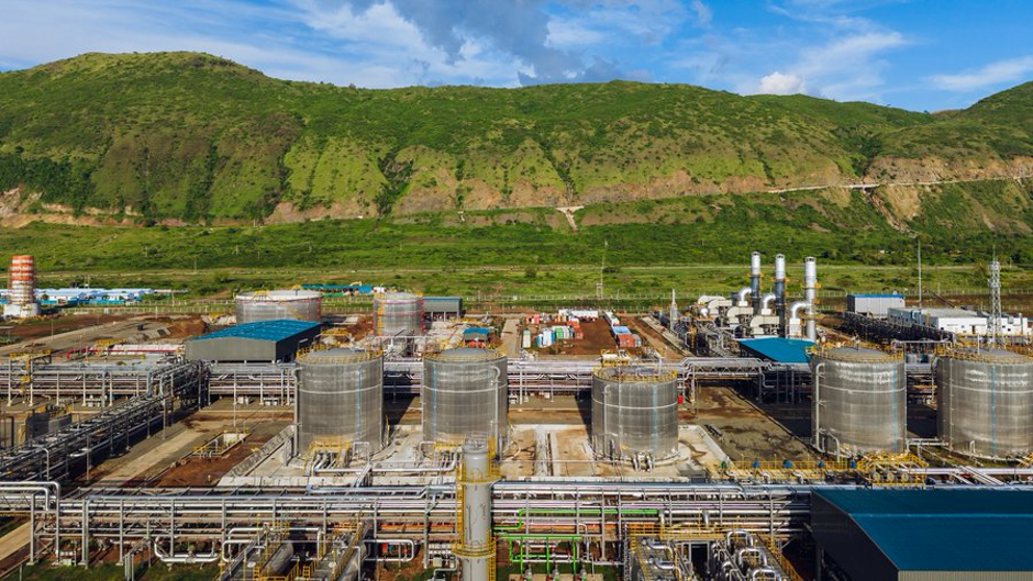
Republic of Uganda
Uganda's petroleum sector has evolved into a strategic driver of economic transformation, industrialization, and regional integration within East Africa. Following decades of geological, geophysical, and exploration activities in the Albertine Graben, Uganda achieved its first commercial oil discoveries in 2006 at the Mputa and Waraga wells in the Lake Albert Basin.
Subsequent exploration and appraisal activities have confirmed approximately 6.5 billion barrels of oil in place, of which an estimated 1.4 billion barrels are recoverable. The country is now transitioning from exploration to production and is poised to join the ranks of oil-producing nations.
PETROLEUM GOVERNANCE AND REGULATORY FRAMEWORK
Uganda has established one of Africa's most comprehensive petroleum governance frameworks, designed to ensure sustainable and responsible development of its petroleum resources. The framework is anchored on:
- The National Petroleum Policy, 2025;
- The Constitution of the Republic of Uganda;
- The Petroleum (Exploration, Development and Production) Act, 2013;
- The Petroleum (Refining, Conversion, Transmission and Midstream Storage) Act, 2013;
- Petroleum regulations and environmental legislation;
- Land management laws; and
- Petroleum revenue management legislation.
These instruments collectively govern petroleum activities across the entire value chain—from exploration and production to transportation, refining, revenue management, and decommissioning—while promoting environmental stewardship, national participation, and socio-economic development.
Key Achievements
Uganda has successfully:
- Established key sector institutions, including the Petroleum Authority of Uganda and Uganda National Oil Company;
- Enacted comprehensive petroleum legislation and regulations;
- Developed national content policies and implementation frameworks;
- Reached Final Investment Decisions (FID) for the Tilenga, Kingfisher, and East African Crude Oil Pipeline (EACOP) projects;
- Mobilized significant investment into strategic infrastructure supporting petroleum development.
UPSTREAM PETROLEUM SECTOR
Uganda is currently transitioning from the exploration phase to petroleum production and export infrastructure development. This is premised on three major development projects namely;
- The Tilenga Project, located in Buliisa and Nwoya Districts and operated by TotalEnergies. It is one of the largest upstream petroleum developments in East Africa.
- The Kingfisher Development Project in Kikuube District operated by CNOOC Uganda Limited forms a critical component of Uganda's initial production portfolio.
- The East African Crude Oil Pipeline (EACOP) provides the export route for Uganda's crude oil to international markets through Tanzania.
With construction activities progressing steadily, Uganda is on course to commence commercial oil production in 2026, marking a historic milestone in the country's energy sector development.
Continued Exploration Efforts
Beyond the Albertine Graben, exploration efforts continue in frontier basins to ensure the sustainability of Uganda's petroleum resource base.
- The Uganda National Oil Company (UNOC) is currently undertaking exploration activities within the Kasurubanu Contract Area.
- Government-led Geological, Geophysical and Geochemical investigations are ongoing in the Kyoga and Moroto-Kadam Basins.
- Furthermore, Uganda is expected to launch its Third Licensing Round before the end of 2026, providing additional opportunities for investment and expanding exploration activities across the country's prospective sedimentary basins.
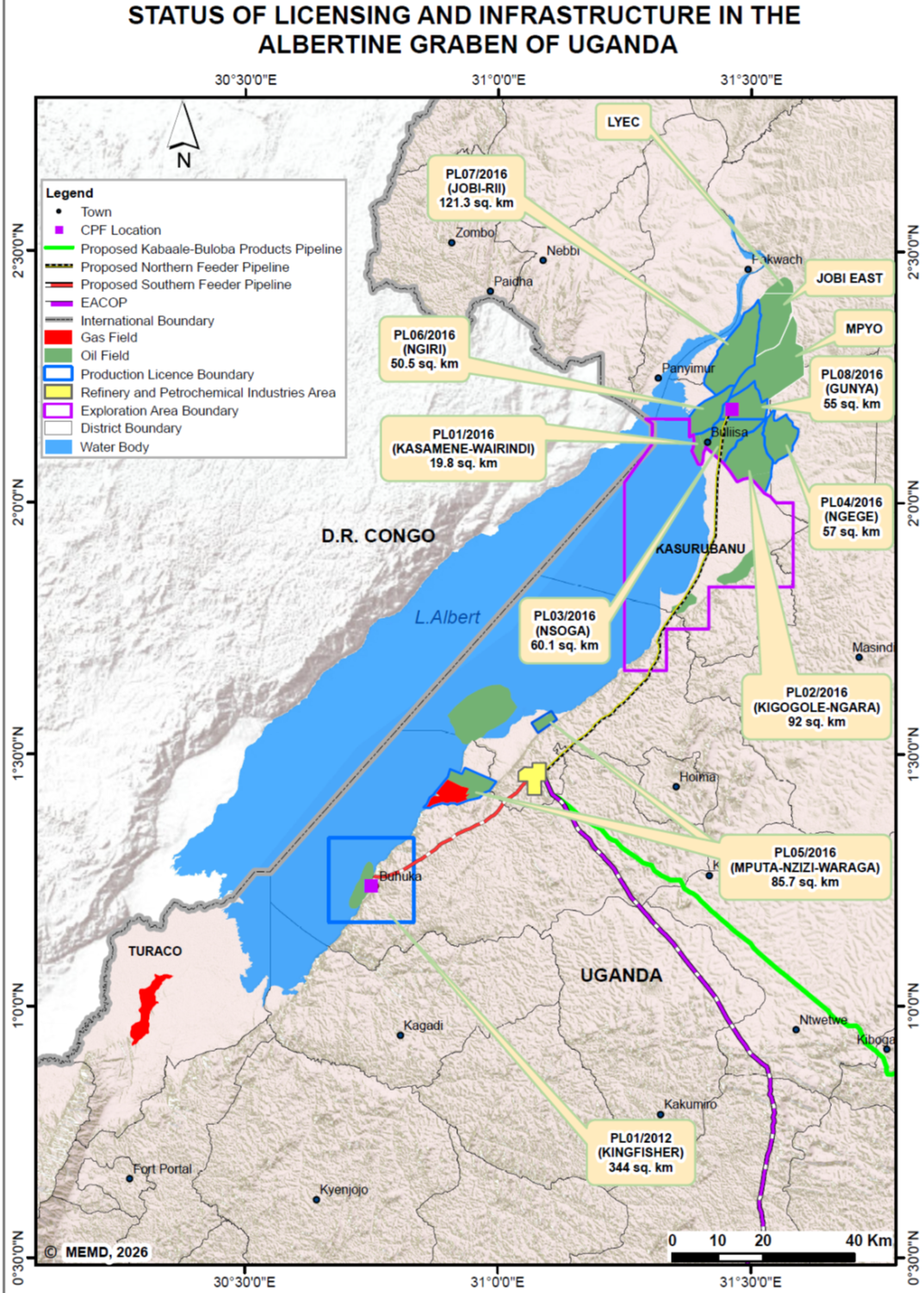 Status of Licensing in the Albertine Graben of Uganda
MIDSTREAM PETROLEUM SECTOR
East African Crude Oil Pipeline (EACOP)
The East African Crude Oil Pipeline (EACOP), which will transport crude oil from Uganda's Albertine Graben to the port of Tanga in Tanzania, has made significant progress and is now in its final stages of construction.
The 1,443-km heated pipeline had reached 85.7% overall completion by the first quarter of 2026, with all line pipes delivered, extensive welding and burial works completed, and major progress achieved on pump stations and export terminal facilities. The project remains on schedule to support Uganda's first oil production and export targets in by end of 2026.
Key milestones achieved include:
- Completion of land acquisition along the Ugandan route.
- Over 1,400 km of pipeline welded and significant sections buried.
- Progress on Pump Station 1 in Hoima and Pump Station 2 in Sembabule.
- Marine Storage and Terminal facilities in Tanga nearing completion, with the export jetty over 90.7% complete.
The project is expected to facilitate the export of crude from the Tilenga and Kingfisher developments and support Uganda's transition into an oil-producing nation during the second half of 2026.
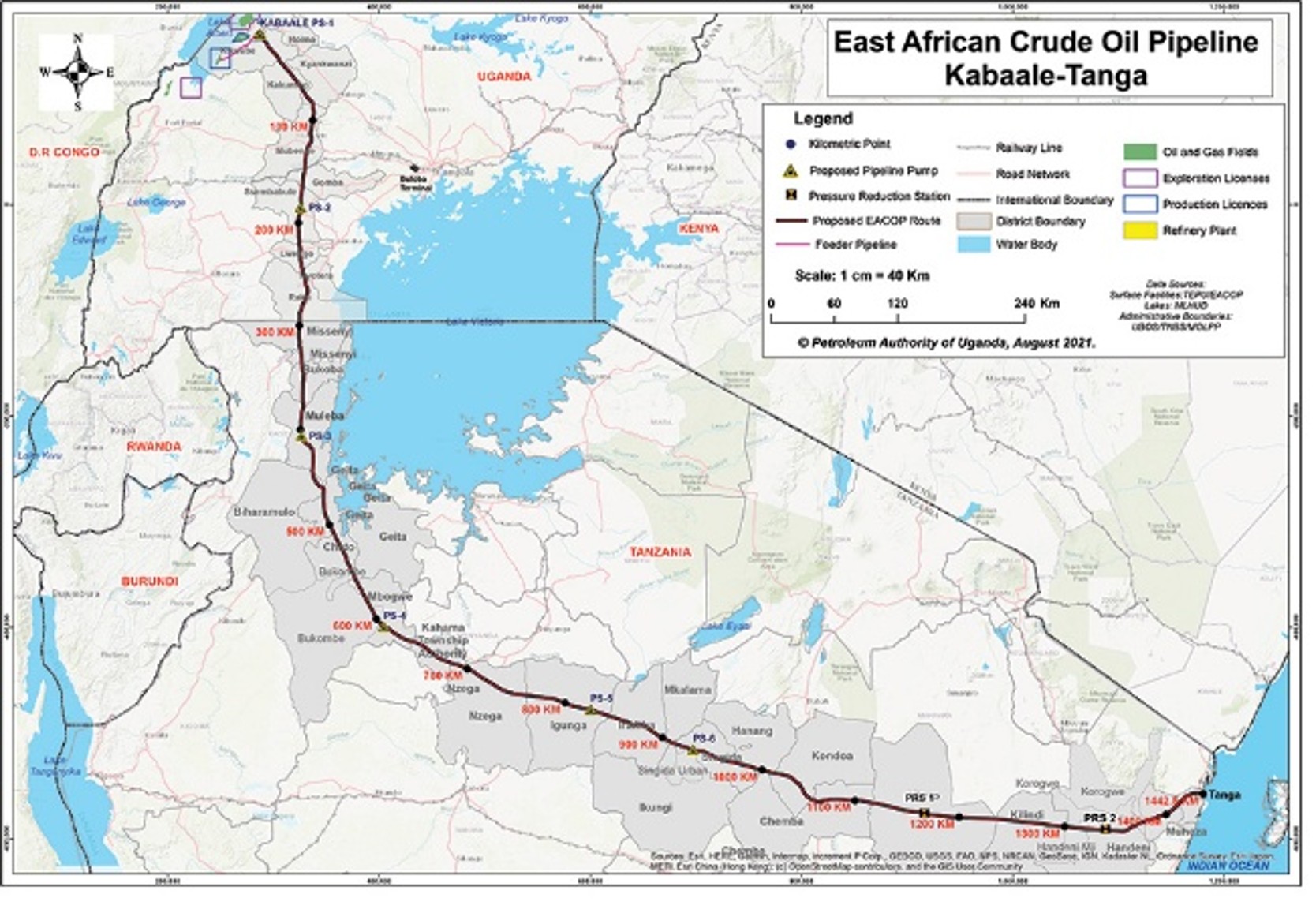 EACOP Right of Way from Uganda to Tanzania
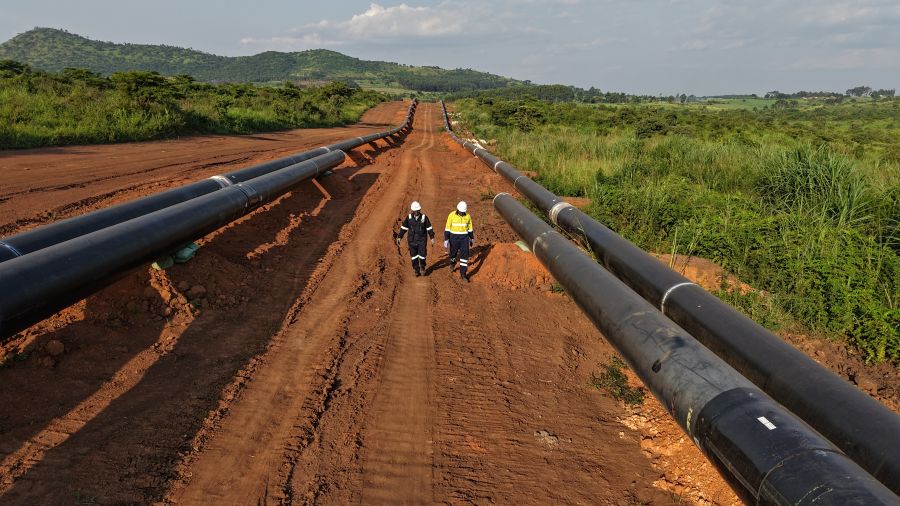 EACOP Project Line Pipes being laid
Uganda Refinery Development
Uganda continues to pursue the development of the 60,000 barrels per day Uganda Refinery Project at Kabaale, Hoima District, as part of its strategy to maximize value addition from its petroleum resources. The refinery is intended to supply petroleum products to Uganda and the wider East African region, reducing dependence on imported fuels.
Current efforts are focused on:
- Finalization of project structuring and financing arrangements.
- Engagement with the refinery project company and potential investors.
- Development of supporting infrastructure within the Kabaale Industrial Park, including roads, power, water supply, and the Kabalega International Airport.
- Integration of the refinery with the planned petrochemical and industrial hub in Hoima.
The refinery remains a strategic national project under the National Oil and Gas Policy and is expected to play a critical role in enhancing energy security, creating employment, promoting industrialization, and generating additional value from Uganda's petroleum resources once implemented.
EMERGING REGIONAL ENERGY INFRASTRUCTURE PROJECTS
Uganda and Tanzania are jointly advancing feasibility studies for two strategic regional energy infrastructure projects, namely:
- a Natural Gas Transmission Pipeline from Tanzania to Uganda and
- a Bi-Directional Refined Petroleum Products Pipeline connecting the two countries.
These projects are designed to strengthen regional energy security, support industrialization, enhance cross-border trade, and accelerate economic growth across the East African Community. Building on the successful collaboration demonstrated through major regional infrastructure initiatives, the two countries are creating a strong foundation for investment in energy transportation systems that will serve growing industrial, commercial, and domestic energy markets for decades to come.
The proposed natural gas pipeline will provide Uganda with access to Tanzania's significant natural gas resources, creating opportunities for power generation, mineral processing, manufacturing, petrochemicals, fertilizer production, and other energy-intensive industries. At the same time, the bi-directional refined petroleum products pipeline will improve the efficiency, reliability, and flexibility of fuel supply chains within the region by reducing transportation costs, minimizing supply disruptions, and strengthening regional energy resilience. Together, these projects will unlock new economic opportunities, support regional integration, create employment, and stimulate local content development while contributing to sustainable economic transformation.
INVESTMENT OPPORTUNITIES
As the projects advance toward implementation, significant opportunities are emerging for investors, infrastructure funds, development finance institutions, engineering and construction firms, and strategic energy partners. Supported by strong government commitment, growing regional energy demand, and a favorable investment environment, these projects offer the prospect of stable long-term returns through infrastructure ownership, transportation tariffs, capacity agreements, and related commercial opportunities. Investors are invited to participate in shaping East Africa's next generation of energy infrastructure and to partner in delivering projects that will drive regional prosperity, energy security, and sustainable development for generations to come.
Uganda is entering a new phase of petroleum development, transitioning from discovery and exploration to production, value addition, and regional energy integration. Through prudent resource management, strategic infrastructure investments, and a robust regulatory framework, the country is positioning its petroleum resources as a catalyst for sustainable economic transformation, energy security, and shared prosperity within the East African region.